
From MOMOS to AFAZ : The Story Behind Malaysia’s Motorcycle Brands
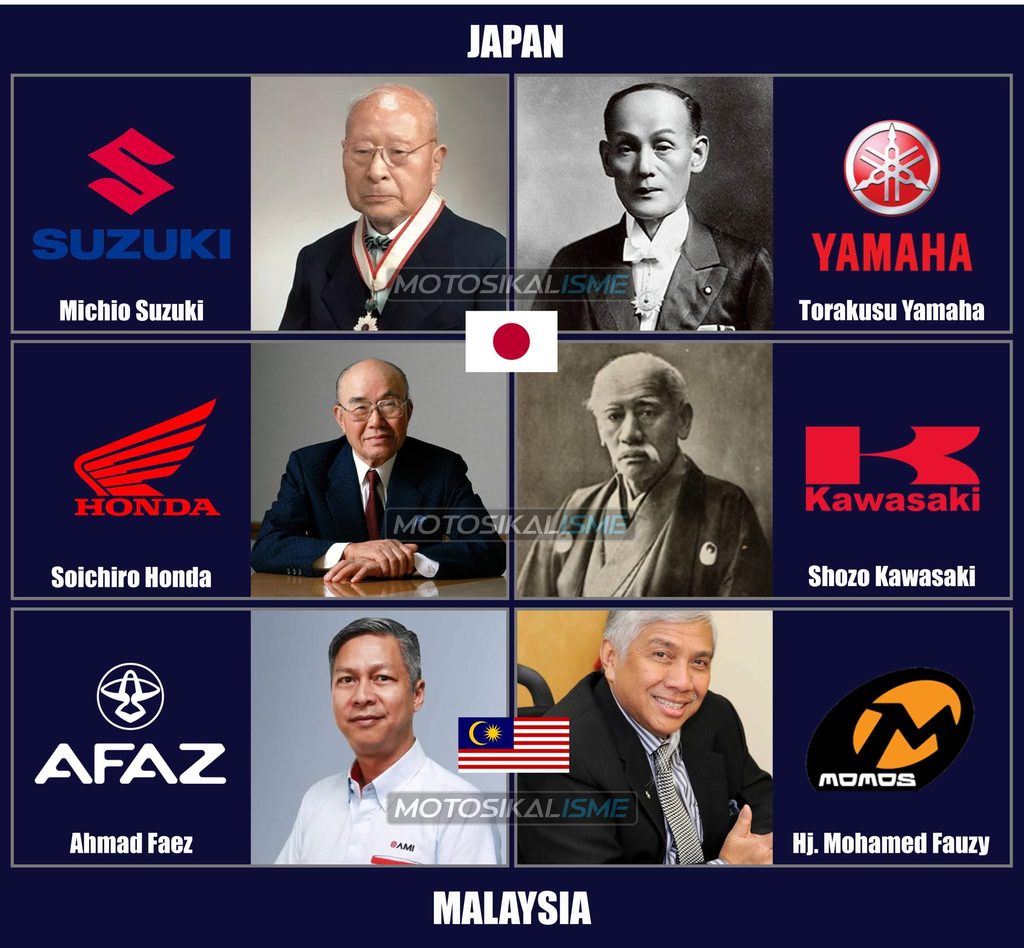
Everyone knows that the four major Japanese motorcycle manufacturers adopted the names of their founders as their official brands.
But did you know that Malaysia has also had motorcycle brands built around the names of their founders?
One example is MOMOS, derived from MOFAZ Motosikal Sdn. Bhd., a motorcycle brand established under MOFAZ, the name itself derived from MOhamed FAuZy. MOMOS began operations in 1980.
Over the years, several MOMOS models appeared in the Malaysian market, and many enthusiasts may still remember names such as the STELLA 125, FORZA, PANTERA, TIGRIS, and MITO.
Although these motorcycles were assembled in Malaysia and, more accurately, could be described as rebadged models, MOMOS was nevertheless a Malaysian motorcycle brand. They were not entirely Malaysian-made, nor were they classified as a national motorcycle manufacturer like MODENAS.
Today, another name has emerged with an even more ambitious story: AFAZ.
AFAZ: The Beginning of a New Chapter
Founded in 2023 by Ahmad Faezy bin Tan Sri Yahaya, AFAZ began its journey through a collaboration between KMSB and Suzuki.
The collaboration formed the foundation for what has been described as Malaysia’s second National Motorcycle project, with its first model, the KENCANA SPORT, recently introduced to the market.
Behind AFAZ is KMSB, a company with a history stretching back to 1975 and a fully Bumiputera ownership structure.
Despite its collaboration with Suzuki, Suzuki Japan does not hold any shares in KMSB. This ownership structure is an important part of the story behind AFAZ and its positioning as a Malaysian-owned motorcycle brand.
But to understand AFAZ properly, we need to go back much further.
1975 — The Kawasaki Connection Begins
KMSB has a long and interesting history, one that is closely connected to Kawasaki.
The story began in 1975, when the company was still known as Dan Motor Sdn. Bhd. At the time, it held a Manufacturing Licence to produce CKD motorcycles, including the JOY and HONEY 100.
This marked the beginning of the company’s involvement in motorcycle manufacturing and assembly in Malaysia.
1984 — Dan Motor Becomes Kawa Motors
In 1984, Bumiputera shareholders entered Dan Motor Sdn. Bhd., leading to the company being renamed Kawa Motors Sdn. Bhd.
Under the same manufacturing licence, the company continued producing CKD Kawasaki models, including the JOY, HONEY 100, AR80, and AR125.
This period represented an important stage in the development of local motorcycle assembly capabilities.
1987 — Kawasaki Sunrock
In 1987, Kawasaki Heavy Industries (KHI) acquired a shareholding in the company. Following this development, the company was renamed Kawasaki Sunrock Sdn. Bhd.
Its CKD production portfolio subsequently expanded to include models such as the:
- MAX 100
- EN500
- ZXR 250
- ZZR 250
- KR150
- SERPICO 150
- VICTOR 150
The company was now firmly established within Malaysia’s motorcycle manufacturing and assembly landscape.
The MAX 110 and the Birth of the Kriss
Another interesting chapter involved the MAX 110.
The model, previously produced by KMSB, was eventually transferred to MODENAS, where it became the foundation for the development of the MODENAS KRISS 110.
This represents one of the lesser-known links between KMSB’s manufacturing history and one of Malaysia’s most recognisable national motorcycle models.
1998 — A Change of Direction
Following the production of these models, CKD motorcycle manufacturing was gradually scaled back.
From 1998, KMSB was directed to reduce its operations and eventually close its motorcycle assembly plant in Port Klang. The company subsequently focused more heavily on CBU high-capacity motorcycles.
For a period, the company’s role in local motorcycle assembly entered a quieter phase.
That would eventually change.
2007 — CKD Production Returns
In 2007, motorcycle CKD production resumed with a new assembly facility in Glenmarie, Shah Alam.
By this time, Kawasaki Sunrock had been renamed Kawasaki Motors Malaysia Sdn. Bhd.
The facility produced and assembled a number of Kawasaki models, including the:
Ninja 250, Z250, ER-6N, KR150RR, Z125, and KLX150.
The return of CKD production marked another important chapter in the company’s involvement in Malaysia’s motorcycle manufacturing industry.
2021 — The KMSB Era Begins
In 2021, as part of a new strategic direction, Kawasaki Motors Malaysia changed its name to KMSB Motors Sdn. Bhd.
This marked the beginning of another new chapter.
KMSB subsequently became the manufacturer and assembler of Suzuki motorcycles in Malaysia. In 2022, the first three Suzuki models introduced under this new arrangement were the:
- Suzuki Raider R150FI
- Suzuki GSX-R150
- Suzuki GSX-S150
Interestingly, the assembly plant remained at the same Glenmarie location. The most visible difference was the change in corporate identity — the facility that was once associated with Kawasaki’s green branding now carried Suzuki’s blue identity.
2022 — The AFAZ Project Begins
Also in 2022, the groundwork for the second National Motorcycle project began with an agreement between KMSB and Suzuki Motor Japan.
Under the collaboration, Suzuki became the technical partner and official engine supplier for AFAZ.
Developing a completely new motorcycle engine from scratch is an enormous undertaking. It requires substantial infrastructure, advanced engineering expertise, technology, investment and development time.
Rather than starting entirely from zero, AFAZ’s decision to utilise an established Suzuki engine platform provided a more practical route towards production.
It allows the project to leverage existing Suzuki technology while potentially reducing development costs and shortening the time required to bring the motorcycle to market.
More Than Just a Motorcycle
What makes the AFAZ story particularly interesting is that a motorcycle is not simply a frame, engine and bodywork.
A modern motorcycle consists of hundreds of individual components, and the development of AFAZ has created opportunities for local suppliers to become part of its manufacturing ecosystem.
According to the project information, 24 local vendors are involved in producing components for AFAZ motorcycles.
That makes the project about more than simply putting a Malaysian badge on a motorcycle. It represents an attempt to build a wider local supply chain around a new Malaysian motorcycle brand.
KENCANA SPORT — More Than a Rebadge
The first AFAZ model, the KENCANA SPORT, is not simply a 100% rebadged motorcycle — in other words, it is not merely a case of putting a Malaysian logo onto an existing model.
A future facelifted model is also expected, and it is not being developed by Suzuki.
Instead, the development is being undertaken by AMITEC Technology Sdn. Bhd., one of the subsidiaries under AMI.
The KENCANA SPORT itself can be seen as an evolution inspired by the Suzuki Smash FI, but with further development and the incorporation of Malaysian-made components.
What Comes Next?
The current AFAZ model line-up begins with:
A01 — KENCANA SPORT
A02 — ?
A03 — ?
From Dan Motor in 1975, through the Kawa Motors and Kawasaki Sunrock eras, to Kawasaki Motors Malaysia, then KMSB Motors, and ultimately the birth of AFAZ, the journey spans almost five decades of Malaysia’s motorcycle industry.
The next chapter has yet to be written.