
1997 — SUZUKI FX125 Breaking Away from the Competition
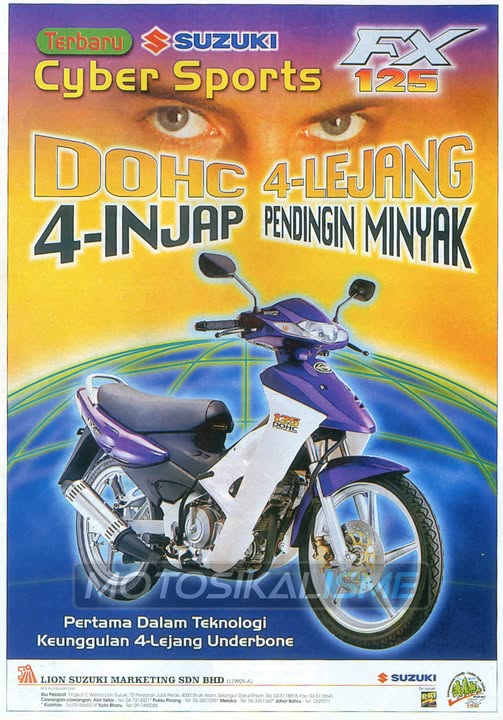
In 1997, Suzuki took a completely different approach from its competitors, who were still largely focused on producing 100–110cc four-stroke underbone motorcycles.
Looking back, Suzuki had already introduced the GSX110 in 1996, the first 110cc four-stroke motorcycle of its kind in Malaysia, effectively creating a new motorcycle category in the Malaysian market.
It also established the perception that 110cc motorcycles could be more powerful and faster than evergreen models such as the Honda EX5.
At the same time, the two-stroke phenomenon was sweeping across the market, with models such as the Yamaha 125Z gaining popularity. Suzuki, however, took a different route by introducing a 125cc four-stroke machine in the form of an Underbone Sports motorcycle.
Unlike the conventional four-stroke underbones of the era, Suzuki focused on creating a machine with a much more sporty and performance-oriented character.
When it was introduced in 1997, the motorcycle looked remarkably unfamiliar compared with anything else on the Malaysian market. In the history of four-stroke underbone motorcycles in Malaysia, it was the first to feature:
- A 125cc air-cooled, inclined engine. Most four-stroke underbones at the time used horizontally mounted engines.
- An oil-cooling system using an oil radiator. Other motorcycles relied solely on air cooling through cooling fins on the engine block.
- A DOHC, four-valve engine. Other motorcycles were still using simpler SOHC, two-valve configurations.
- A five-speed transmission. Most competing motorcycles were still equipped with four-speed gearboxes.
- A one-down, four-up gear pattern. Other motorcycles generally used a conventional all-down shifting pattern.
- A manual clutch. Other underbones did not come with a hand-operated clutch.
- A monoshock rear suspension system. Other motorcycles still relied on twin rear shock absorbers.
- A twin-spar chassis. Other underbones continued to use conventional chassis designs.
- A front-mounted gear lever system. Riders had to physically press and hook the gear lever to shift gears, as there was no rear linkage or heel shifter.
- A vacuum carburetor system, where the diaphragm played a key role in controlling the movement of the carburetor slide.
- A maximum output of 13.3 hp at 10,500 rpm from a standard engine. At the time, conventional 110cc four-stroke engines generally produced no more than around 9 hp.
Even across the wider Asian region, the Suzuki FX125 was essentially the first 125cc four-stroke Underbone Sports motorcycle of its kind to be introduced.
For the first time, Suzuki Japan selected Malaysia as the launch market for this new model and also made the country its production base for export markets, following the same strategy previously adopted for its bigger sibling, the FXR150.
Several years later, the motorcycle was produced in Thailand in the form of the Suzuki Raider 125. Honda subsequently followed with the Honda Sonic 125 in 2001, adopting a concept similar to the FX125 and Raider 125.
In Thailand, these two models went head-to-head not only in the marketplace but also on the local racing circuit.
Our neighbours, the Philippines and Indonesia, received the Raider 125 in CBU form from Thailand only in 2002.
It was not until seven years later that the Yamaha LC135 emerged and, to a significant extent, began dominating the market following its introduction in 2005.
Even before that, however, Suzuki had already presented the Suzuki Raider R150 in 2004, featuring an oil-cooled engine, as its answer to the Honda Sonic 125.
If you were once the owner of an FX125, or still own one today, you should be proud of the machine sitting in your garage.
The FX125 was never celebrated or branded with titles such as “King of Mopeds”, nor did it receive any other grand nickname.
It simply appeared, made its mark, and eventually disappeared from the mainstream spotlight.